

[Kansai World Heritage (1) Kyoto Toji Temple]
[“Kyo-o-gokoku-ji Temple”]
[“The Yakushi Triad in the Kondo, the 21 Statues in the Kodo, and the Five Great Space Repository Bodhisattvas in the Kanchiin are viewed as one entity”]
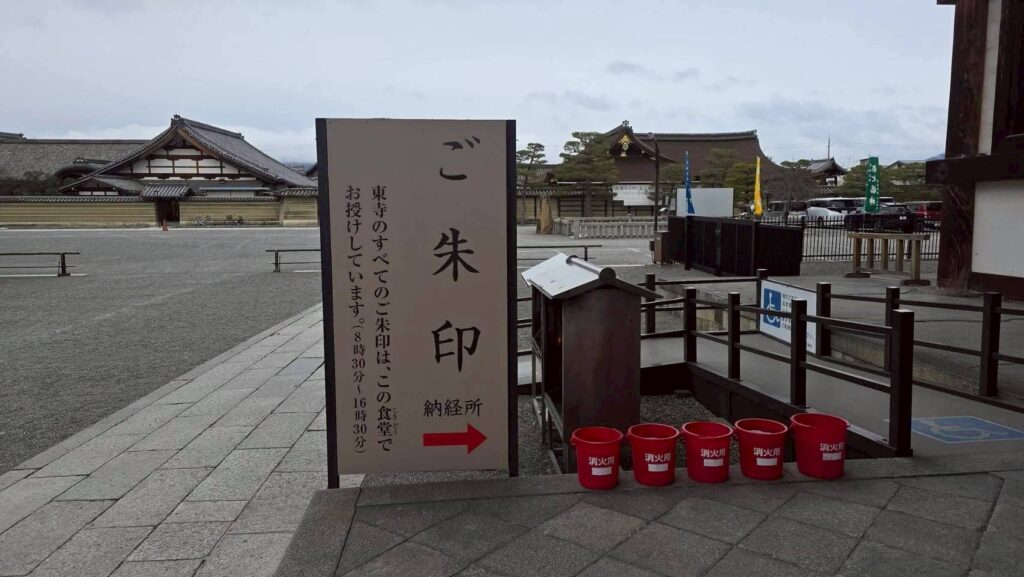
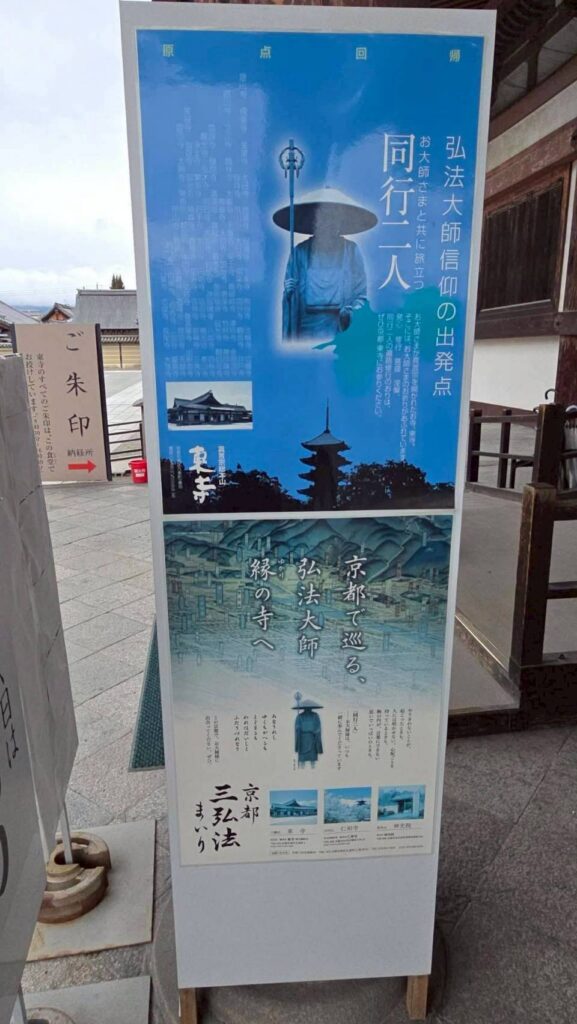
[The starting point for receiving goshuin on the Shikoku Pilgrimage]
[“Boundless sky, perfect wisdom and merit”]
[Kyoto Toji Temple]
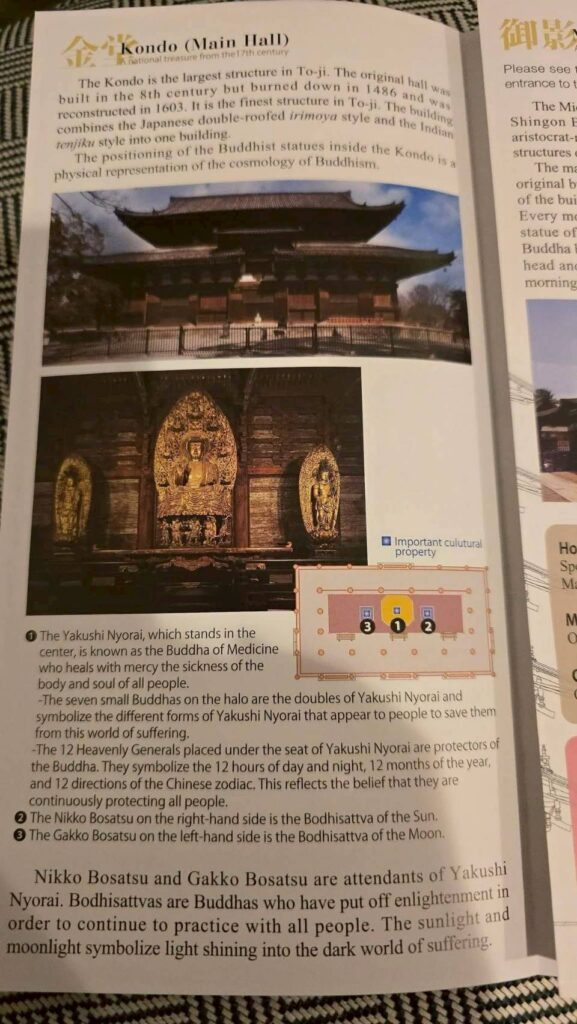
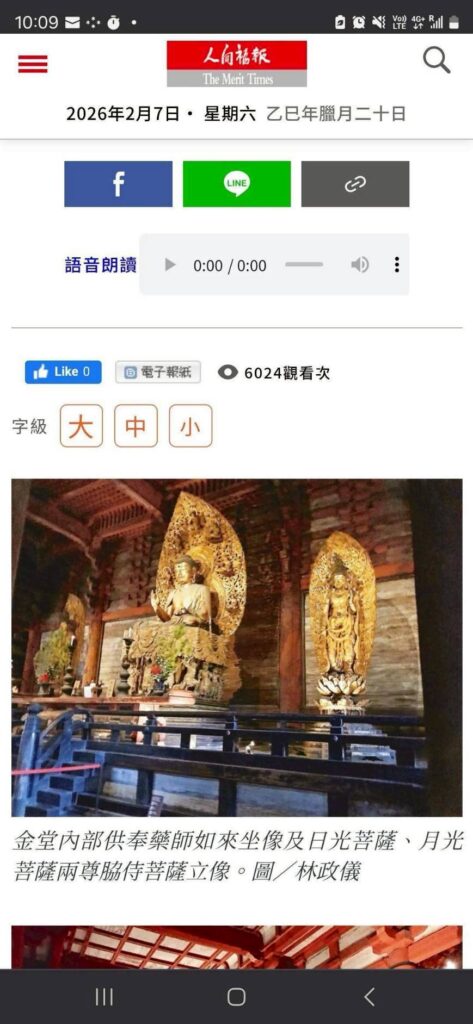
[The Yakushi Nyorai Triad, Seven Buddhas, and 12 Heavenly Generals in the Toji Kondo]
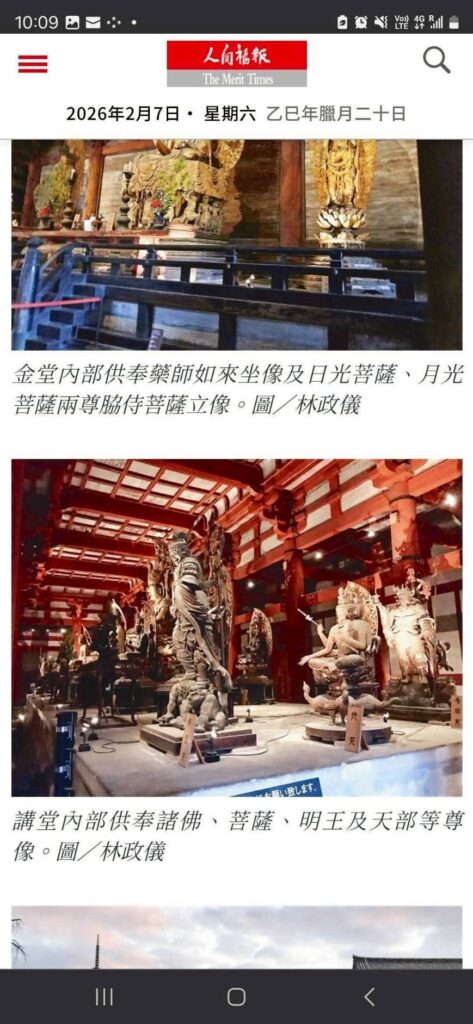
[Kukai’s 21 Buddhist statues in the Toji Kodo]
[The 21 statues in the Toji Kodo and the Five Great Space Repository Bodhisattvas in the Kanchiin]
[“Boundless sky, perfect wisdom and merit”]
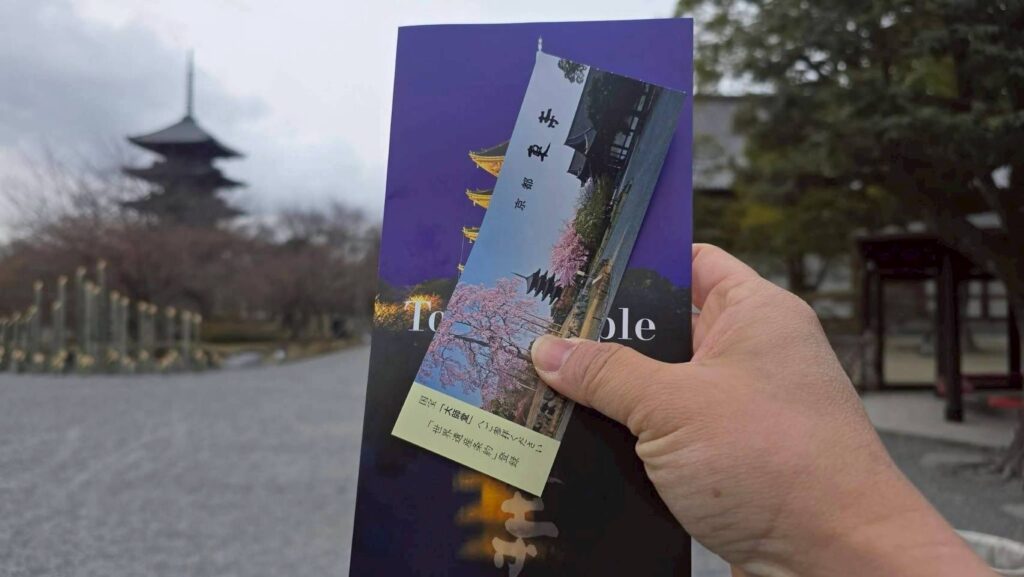
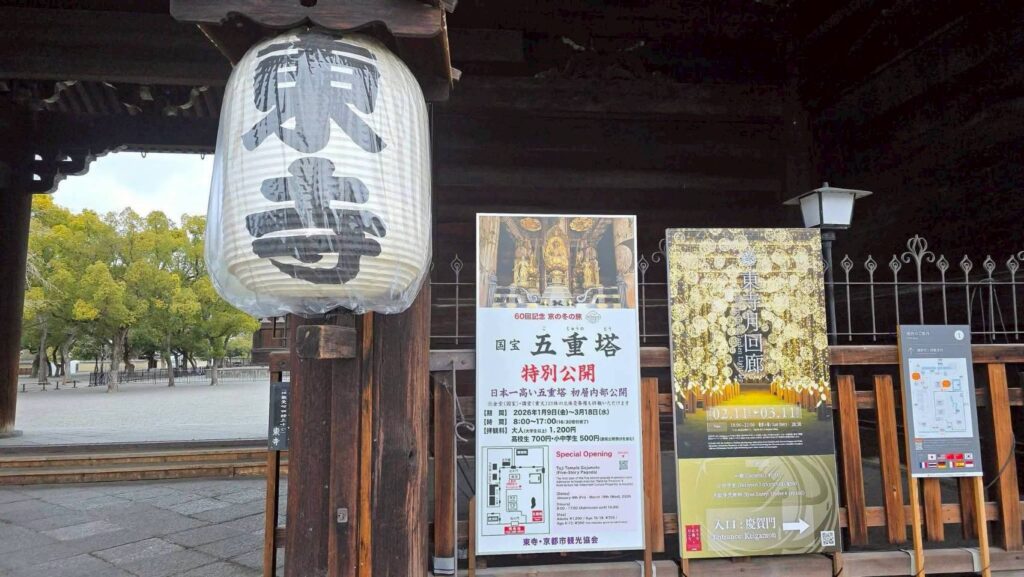
While many travelers to Kyoto might overlook Toji Temple, it holds unparalleled importance for Kobo Daishi Kukai and Shingon Buddhism.
https://www.backpackers.com.tw/forum/showthread.php?t=1430909
Toji Temple in Kyoto is one of the Three Great Temples (San-Kobo) of the Shikoku Pilgrimage and serves as the starting point for collecting goshuin (temple seals).
The origin of the pilgrimage in Taiwan:
The footprints of Kukai from Ximending to Ji’an Township in Hualien, shared during the pandemic.
Many people are unaware that Taiwan once had a complete “New Shikoku 88 Temple Pilgrimage.” The source of this path of faith has a deep bloodline connection to Toji Temple in Kyoto.
https://www.facebook.com/share/1D5b8MqJap
1. Taipei Tianhou Temple (formerly Kobo-ji): The Starting Point of the Pilgrimage in the City
Taipei Tianhou Temple, located in the bustling Ximending area, was originally the founding site of the New Shikoku 88 Temple Pilgrimage. Back then, Japanese monks and believers set up 88 stone Buddha statues around the Taipei Basin to simulate the Shikoku Pilgrimage.
In a corner of Tianhou Temple, a statue of Kobo Daishi is still enshrined today. For enthusiasts of ancient trails, this is not just a religious site, but a crossroads of Taiwan’s urban development history and Japanese religious immigration history. Starting from here, much like receiving a “Nokyo-cho” (stamp book) at Toji Temple in Kyoto, symbolizes embarking on a long journey to find oneself.
2. Hualien Yoshino Missionary Office (Qingxiu Temple): Esoteric Buddhism Left Behind in Eastern Taiwan
If Taipei is the starting point of the pilgrimage, then Qingxiu Temple in Hualien is the most completely preserved esoteric Buddhist architecture in Taiwan.
The 88 stone Buddha statues of Qingxiu Temple: This place collected sacred soil and replica stone statues from the 88 temples in Shikoku, allowing immigrants who could not cross the sea back to Japan at the time to complete a “miniature pilgrimage” right here.
The embodiment of perfect wisdom and merit: Walking along the corridors of Qingxiu Temple and looking at the neatly arranged stone statues, the core spirit behind them is exactly the “boundless sky” emphasized by Toji Temple. For ancient trail lovers, every statue here carries the sweat and faith of the pioneers during the Taisho and Showa eras.
Toji Temple was established in 794, when the capital was “Heian-kyo” (present-day Kyoto).
When “Heian-kyo” was built, the official temple established to protect the eastern side of the capital was Toji Temple, also known as “Kyo-o-gokoku-ji Temple.”
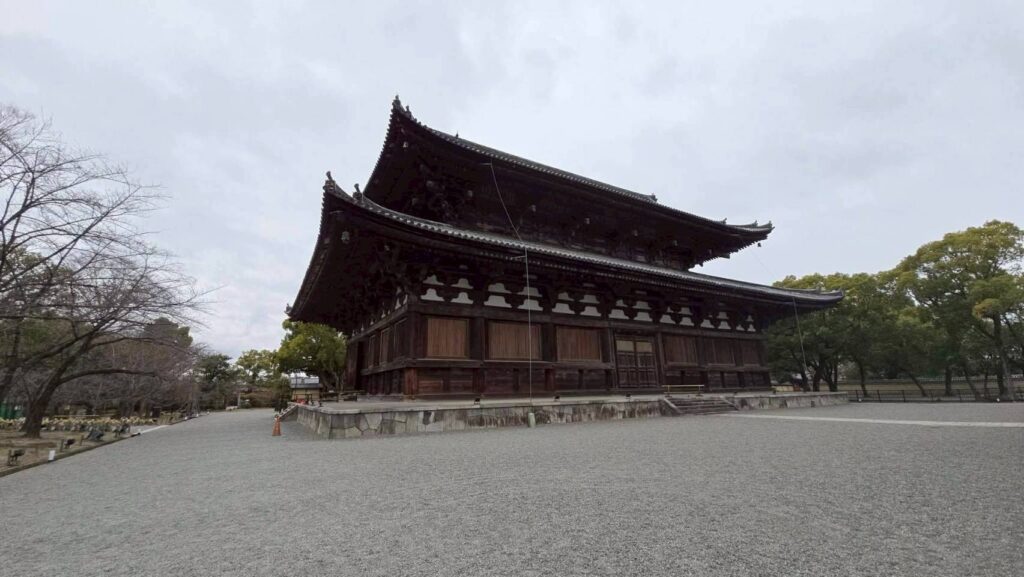
The Starting Point of the Shikoku Pilgrimage
Located about a 15-minute walk from the Hachijo East Exit of Kyoto Station, “Toji Temple” is officially named “Kyo-o-gokoku-ji Temple.”
This temple is the head temple of Shingon Buddhism, built by Kobo Daishi Kukai. Founded in 796, it boasts over 1,200 years of history.
In 1994, Toji Temple was registered as a World Heritage site as part of the “Historic Monuments of Ancient Kyoto.”
The grounds are home to national treasures such as the “Five-Story Pagoda” (a symbol of Kyoto), the “Miei-do” (the residence of Kobo Daishi Kukai), and the “3D Mandala,” which visually presents esoteric teachings. These precious architectures and temple treasures allow visitors to feel the history of the temple and the teachings of Shingon Buddhism. Cherry blossoms in spring and red leaves in autumn add beautiful scenery to the grounds.
[The starting point of the Shikoku Pilgrimage]
[Kukai’s 21 Buddha statues in the Toji Kodo]
Taking advantage of the kids not being awake yet, I quickly headed to Toji Temple.
Toji Temple has a profound connection with Kobo Daishi “Kukai” (774-835). Kobo Daishi was widely known for his vast knowledge, and was both a master builder and a renowned calligrapher. In 823, Emperor Saga (786-842) bestowed this temple upon Kukai. The following year, Kukai was appointed “Betto” (administrator of temple affairs). Afterward, to make Toji Temple the fundamental dojo of Shingon Esoteric Buddhism, he repaired the Kodo (Lecture Hall), built the Five-Story Pagoda, and expanded the scale of the temple. Buddha statues and architectural marvels are everywhere on the temple grounds, and a large number of Mandala paintings are treasured inside, visually depicting the myriad worlds of Buddhism.
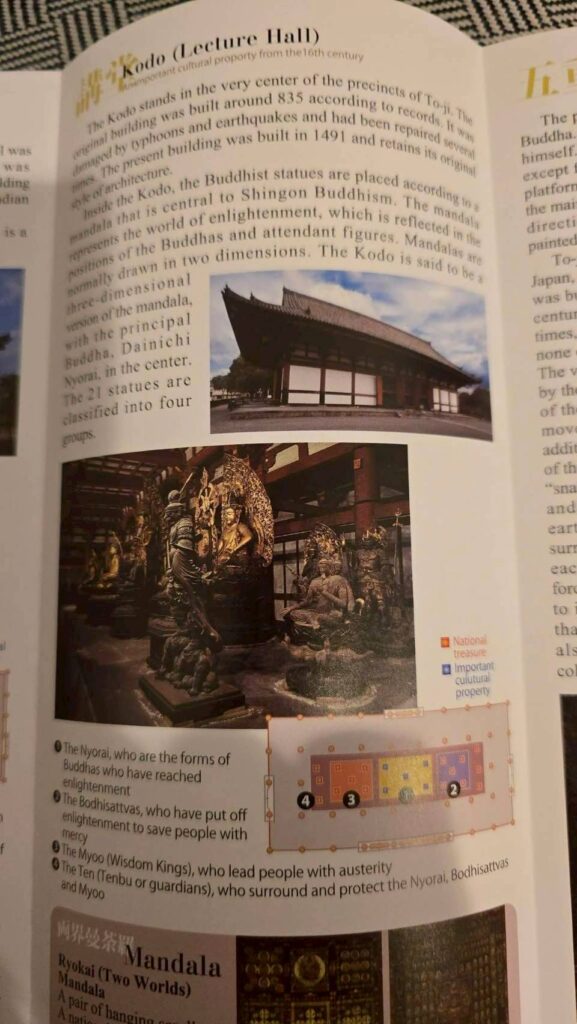
In the Kodo of Toji Temple (Kyo-o-gokoku-ji), Kobo Daishi Kukai arranged 21 Buddha statues, which is known as the “3D Mandala.” These 21 statues are not arranged randomly, but expand outward with the Five Wisdom Buddhas at the center, according to esoteric teachings.
These 21 Buddhas can be divided into the following five groups:
1. The Five Wisdom Buddhas (Center)
Symbolizing the center of the highest wisdom and truth in Esoteric Buddhism.
- Dainichi Nyorai (Center, core principal deity)
- Ashuku Nyorai (East)
- Hosho Nyorai (South)
- Amida Nyorai (West)
- Fuku-joju Nyorai (North)
2. The Five Great Bodhisattvas (Right / East)
Symbolizing compassion, they assist the Nyorai in educating sentient beings.
- Kongo-Haramitsu Bodhisattva (Center)
- Kongo-Satta Bodhisattva (East)
- Kongo-Ho Bodhisattva (South)
- Kongo-Ho (Dharma) Bodhisattva (West)
- Kongo-Go Bodhisattva (North)
3. The Five Great Wisdom Kings (Left / West)
Symbolizing the subjugation of stubborn sentient beings with fierce power.
- Fudo Myo-o (Center)
- Gozanze Myo-o (East)
- Gundari Myo-o (South)
- Daiitoku Myo-o (West)
- Kongo-Yasha Myo-o (North)
4. The Six Heavenly Deities (Guarding the perimeter)
The guardian deities responsible for protecting the dojo and Buddhist laws.
5. Bonten (At the head of the Six Deities)
- Taishakuten
- Jikokuten (One of the Four Heavenly Kings, East)
- Zochoten (One of the Four Heavenly Kings, South)
- Komokuten (One of the Four Heavenly Kings, West)
- Tamonten (One of the Four Heavenly Kings, North, also known as Bishamonten)
Fudo Myo-o: The Fudo Myo-o in the Kodo is considered the oldest existing Fudo Myo-o statue in Japan. Among these 21 statues, 16 are original national treasures from the early Heian period (9th century) (the remaining 5 Nyorai statues and 1 Kongo-Haramitsu Bodhisattva were remade in later generations).
3D Experience: Standing in the Kodo, you can feel the impact of shifting from a 2D painting (Mandala chart) to a 3D space. This was designed by Kobo Daishi to let believers intuitively feel the world of Buddha.
If you visit the site, it is recommended to start viewing from the central Dainichi Nyorai, and then respectively observe the fierceness of the Wisdom Kings and the compassion of the Bodhisattvas on the left and right sides.
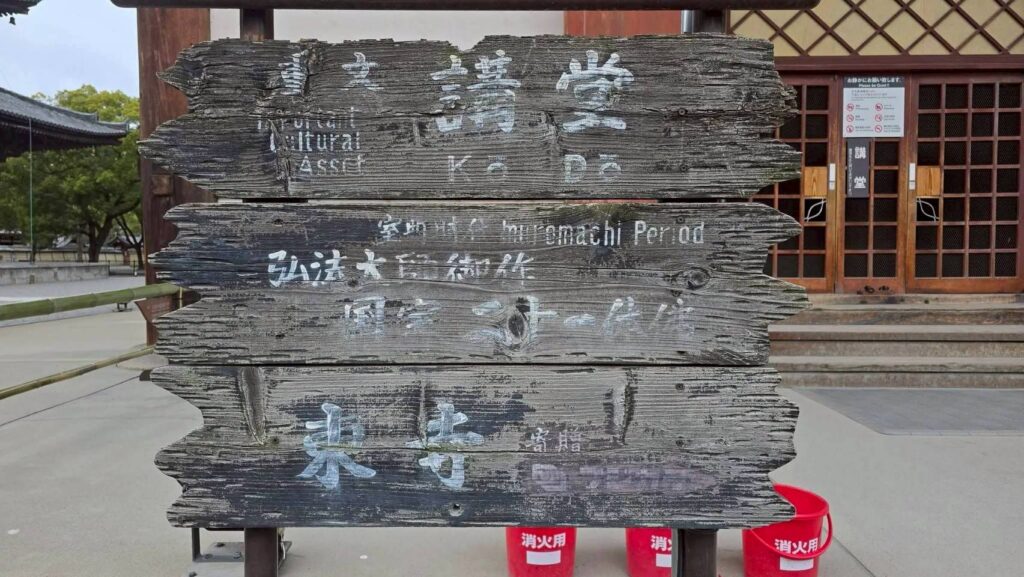
[The 21 Statues of the Toji Kodo and the Five Great Space Repository Bodhisattvas of Kanchiin]
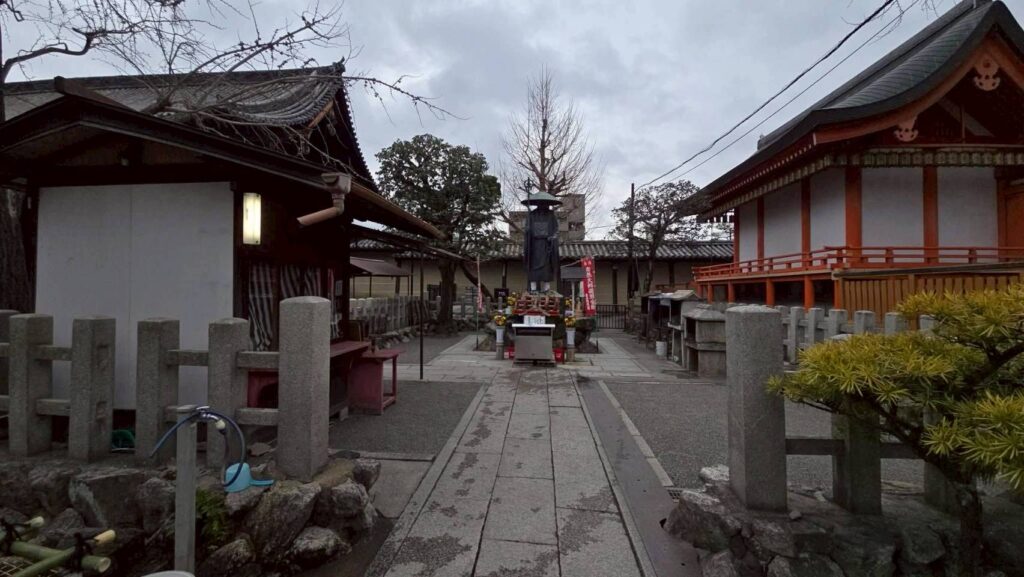
At “Kanchiin,” a sub-temple of Toji Temple.
As for why this set of “Five Great Space Repository Bodhisattvas” has such a deep connection with Kobo Daishi and his lineage, there are three main reasons:
(1) Passed down from Kukai’s disciple “Eun”
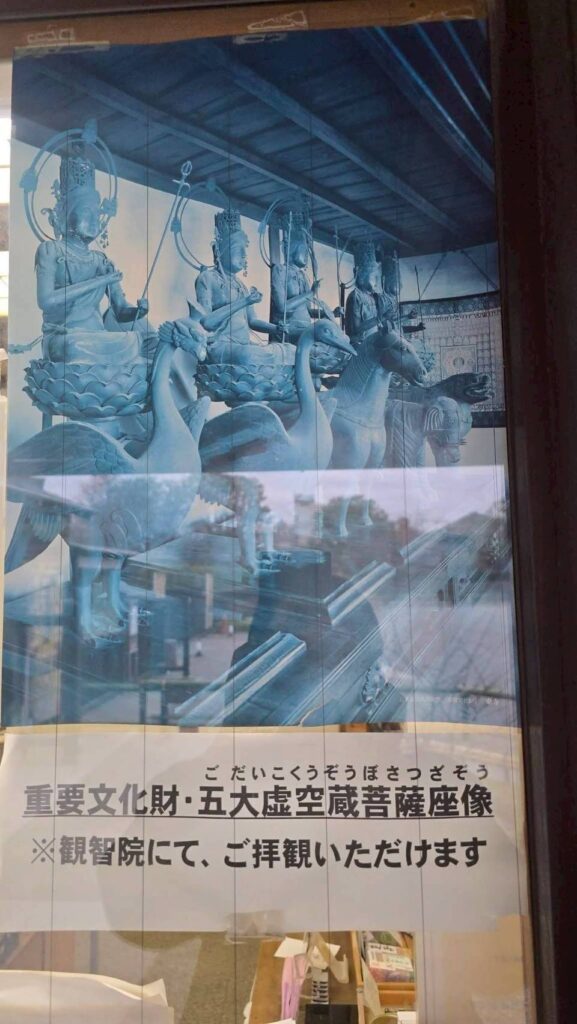
Although the 21 Buddhas in the Toji Kodo were conceived by Kobo Daishi himself, the Five Great Space Repository Bodhisattva statues in Kanchiin were brought back to Japan from Tang Dynasty China in the 9th century by Eun (798-869), Kukai’s Dharma grandson and a Shingon monk. This set of statues is a very rare Tang Dynasty art masterpiece and a symbol of the transmission of the Shingon esoteric lineage.
(2) Core of practice: “Kokuzo Gumonji-ho”
When Kobo Daishi practiced at Mt. Tairyu in Shikoku in his youth, he gained astonishing memory and enlightenment by practicing the “Kokuzo Gumonji-ho” (constantly reciting the name of Kokuzo Bosatsu). Therefore, Kokuzo Bosatsu holds a very high status in Shingon practice and is regarded as an endless treasure house of “wisdom and merit.”
(3) Extension of the 3D Mandala
Although there is already a “3D Mandala” composed of 21 Buddhas in the Kodo, the Five Great Space Repository Bodhisattvas (Hokkai, Kongo, Hoko, Renge, Goyo) are actually another manifestation of the wisdom of the “Five Wisdom Buddhas” (incarnations of the Five Buddhas). Enshrining this set of statues in Kanchiin is to further strengthen the esoteric teachings about “boundless sky and perfect wisdom.”
Toji Temple
Toji Kodo: Here are 21 Buddha statues
(Five Nyorai, Five Bodhisattvas, Five Wisdom Kings, Six Deities).
This is a stunning space personally crafted by Kukai.
Toji Kanchiin: Enshrined here are the Five Great Space Repository Bodhisattvas (special statues sitting on birds and beasts). This is the secret treasure brought back from the Tang Dynasty by Eun, and it is also the center of Toji’s research institute and doctrinal transmission.
In summary: The reason they are linked together is that they collectively form the complete esoteric cosmology of Toji Temple.
The Kodo is a “public place of education,” while Kanchiin (the Five Great Kokuzo) carries more of a “deep practice and transmission” tone.
This is a very profound question regarding the sacred spatial layout of Toji Temple (Kyo-o-gokoku-ji). To understand why the “Yakushi Triad of the Kondo,” the “21 Statues of the Kodo,” and the “Five Great Kokuzo of Kanchiin” are viewed as one entity, we must look at it from the esoteric cosmology established by Kobo Daishi (Kukai).
In the planning of Toji Temple, these three sets of statues do not exist independently, but together form an “exoteric and esoteric unified” map of salvation:
(1) The “Trinity” of Functions: Reality, Truth, and Wisdom
These three sets of statues represent the three levels of a believer’s practice and salvation:
| Area | Core Statues | Represented Meaning | Role and Detailed Description |
| Kondo | Yakushi Triad | Practical Salvation | Yakushi Nyorai is the “Great King of Medicine,” responsible for healing the physical pains and sufferings of sentient beings. It is the exoteric facade of Toji Temple as the “protector of the nation.”
The interior enshrines the principal deity Yakushi Nyorai, flanked by statues of Nikko Bodhisattva and Gakko Bodhisattva. Around the lotus pedestal of Yakushi Nyorai are the Twelve Heavenly Generals guarding the Nyorai, creating a breathtakingly solemn atmosphere. These three statues are designated as Important Cultural Properties as the “Yakushi Triad.” |
| Kodo | 21-Statue 3D Mandala | Esoteric Truth | Centered on Dainichi Nyorai, it reveals the ultimate truth of the universe’s workings. This is Kukai translating invisible doctrines into a tangible space. |
| Kanchiin | Five Great Kokuzo | Wisdom Practice | Kokuzo (Space Repository) symbolizes the “endless storehouse of wisdom” and is the source for monks (like Kukai) to achieve extraordinary memory and enlightenment through practice. |
The Logic of Unity: Believers first seek physical health (Kondo’s Yakushi), then proceed to understand the truth of the universe (Kodo’s Mandala), and finally attain perfect wisdom through practice (Kokuzo).
(2) “Mandala-ization” on the Spatial Axis
The architectural layout of Toji Temple itself is a giant Mandala. Walking from south to north:
- South Gate ➔ Kondo (Yakushi Buddha): Represents entering the world of Buddha.
- Kodo (21 Buddhas): Located at the center of the temple, symbolizing the core of the universe.
- Rear Hall / North Side (Kanchiin / Five Great Kokuzo): Represents deep practice and the storage of wisdom.
This layout turns the entire Toji campus into a “three-dimensional training ground.”
Yakushi Buddha protects sentient beings with peace in this life so that they have the physical strength and lifespan to pursue the higher truths of the Dharma represented by the Kodo and Kanchiin.
(3) Consistency in the Origin of Buddha Nature (Exoteric and Esoteric Harmony)
In esoteric teachings, Yakushi Nyorai, Dainichi Nyorai (center of the Kodo), and Kokuzo Bosatsu are fundamentally interconnected:
- Dainichi Nyorai is the fundamental Buddha of the universe.
- Yakushi Buddha is the incarnation of Dainichi Nyorai showing compassion and healing sentient beings in this world.
- The Five Great Kokuzo are variations of the Five Wisdom Buddhas (the five Buddhas in the Kodo) displaying wisdom and merit.
Why are they one? Because for Kukai, whether it is Yakushi Buddha averting disasters, Fudo Myo-o showing fierceness (one of the 21 in the Kodo), or Kokuzo bestowing wisdom, they are all manifestations of the “same Dainichi Nyorai” in different situations.
(4) The Connection of Historical Lineage: The Starting and Ending Points of Kukai’s Practice
- Starting Point: Kukai achieved enlightenment in his youth by practicing the “Kokuzo Gumonji-ho,” making “Kokuzo” the source of his power.
- Ending Point: He was entrusted to manage Toji Temple, established the “21 Buddhas in the Kodo” to fully present esoteric teachings, and preserved the “Yakushi Buddha in the Kondo” as a tradition for protecting the nation.
The integration of these three symbolizes the complete path “from relief from sickness and suffering (Yakushi), to the realization of universal truth (Kodo), and ultimately attaining perfect wisdom (Kokuzo).” This is why researchers of Toji Temple view these three places as an inseparable entity.
It is very convenient to get to Toji Temple (the headquarters of Kobo Daishi’s Shingon Buddhism) from JR Kyoto Station, as Toji is located just southwest of the station. Depending on your stamina, you can choose to walk or take public transportation:
(1) Walking (Most Recommended, about 15 minutes)
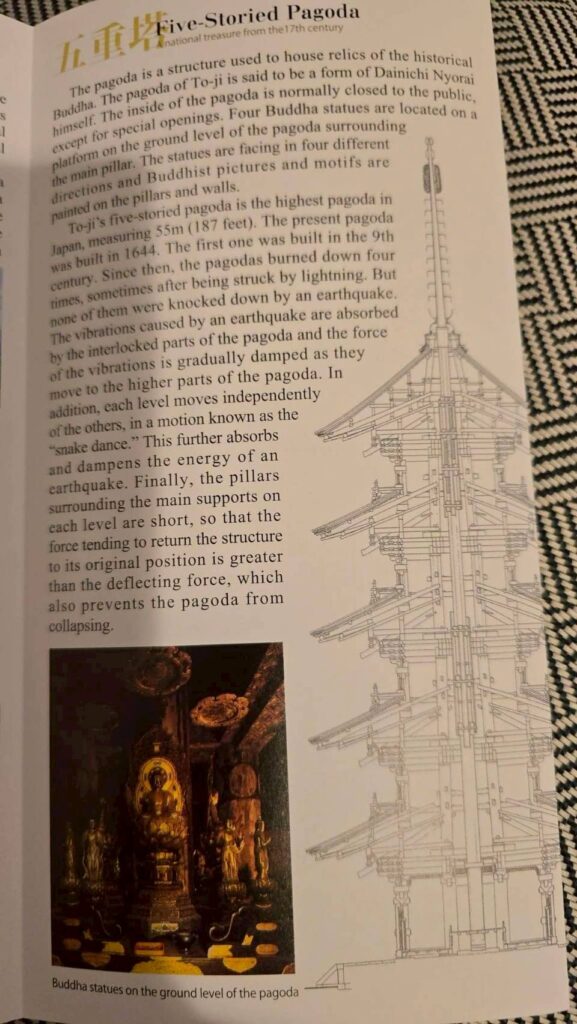
This is the easiest way. There’s no need to wait for a bus or train, and you can see Toji’s famous Five-Story Pagoda from a distance along the way.
- Route: Exit from the “Hachijo Exit” (South Exit) of Kyoto Station and walk straight west along Hachijo-dori.
- Key Landmark: Walk to the intersection with “Aburanokoji-dori” and continue west. Soon, you will see the walls of Toji Temple and the Five-Story Pagoda.
- Distance: About 1.1 kilometers.
(2) Taking the Kintetsu Railway (Fastest, about 5 minutes)
If you want to save your energy, this is the quickest mode of transportation.
- Boarding Location: The “Kintetsu Kyoto Station” platform inside Kyoto Station.
- Line to Take: Kintetsu Kyoto Line (A local train is fine, it’s just one stop).
- Alighting Station: “Toji Station“.
- Next Steps: After exiting the station, walk west for about 5 minutes to reach the “Keigamon” gate of Toji Temple.
(3) Taking the City Bus (About 10 minutes)
- Boarding Location: “Hachijo Exit” Bus Stop at Kyoto Station.
- Recommended Routes: Take Bus No. 16, 19, or 71.
- Alighting Stop: Get off at “Toji Higashimon-mae” or “Toji Minamimon-mae“.
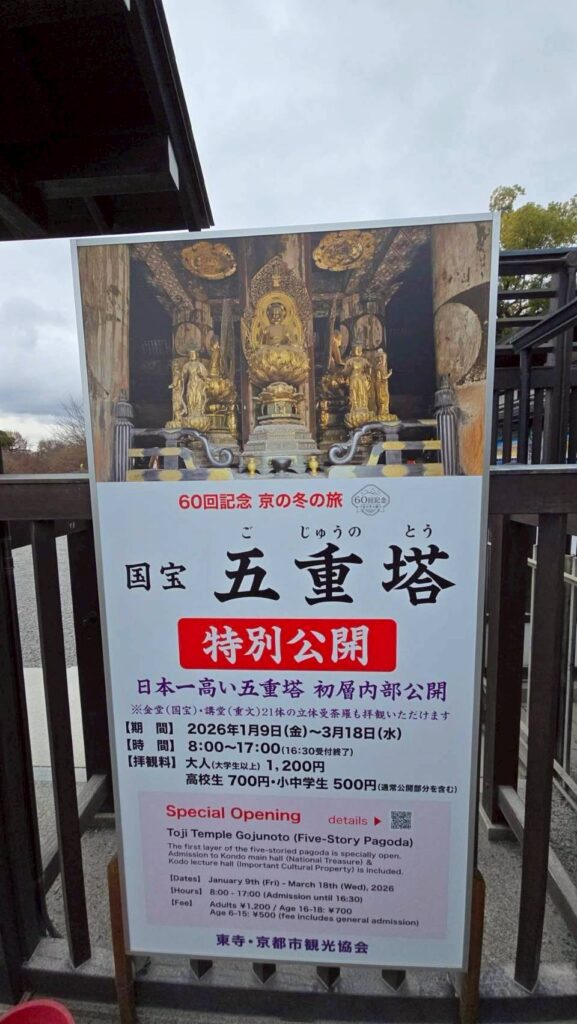
Special Opening of the Five-Story Pagoda Interior
The Five-Story Pagoda of Toji Temple is the tallest wooden pagoda in Japan. The interior is usually closed to the public, but during the “Special Opening” periods in spring and autumn, you can enter the first floor to view the esoteric Mandala world inside.
Kobo-ichi (Flea Market)
If you happen to visit on the 21st of any month, Toji Temple holds a large flea market called “Kobo-ichi.” It is very lively and a great way to deeply experience the atmosphere of “connecting with local life.”
Toji Temple has a completely different atmosphere from the previously visited Higashi Honganji and Nishi Honganji. That sense of esoteric solemnity and Kobo Daishi’s legacy is highly worth experiencing in person.